Geometry help that talks and draws.
A live voice tutor for the whole course, on a whiteboard that reads your student's handwriting. Constructions through circles. In Geometry, drawing the figure is half the work.
Every unit, in the order it's taught.
These are the unit names exactly as they appear inside SmartWit.
- 01Constructions and Rigid Transformations
- 02Congruence
- 03Similarity
- 04Right Triangle Trigonometry
- 05Solid Geometry
- 06Coordinate Geometry
- 07Circles
- 08Conditional Probability
Lessons adapted from Illustrative Mathematics High School Mathematics, © 2019 Illustrative Mathematics, licensed under CC BY 4.0. The Illustrative Mathematics name and logo are not subject to the CC BY license.
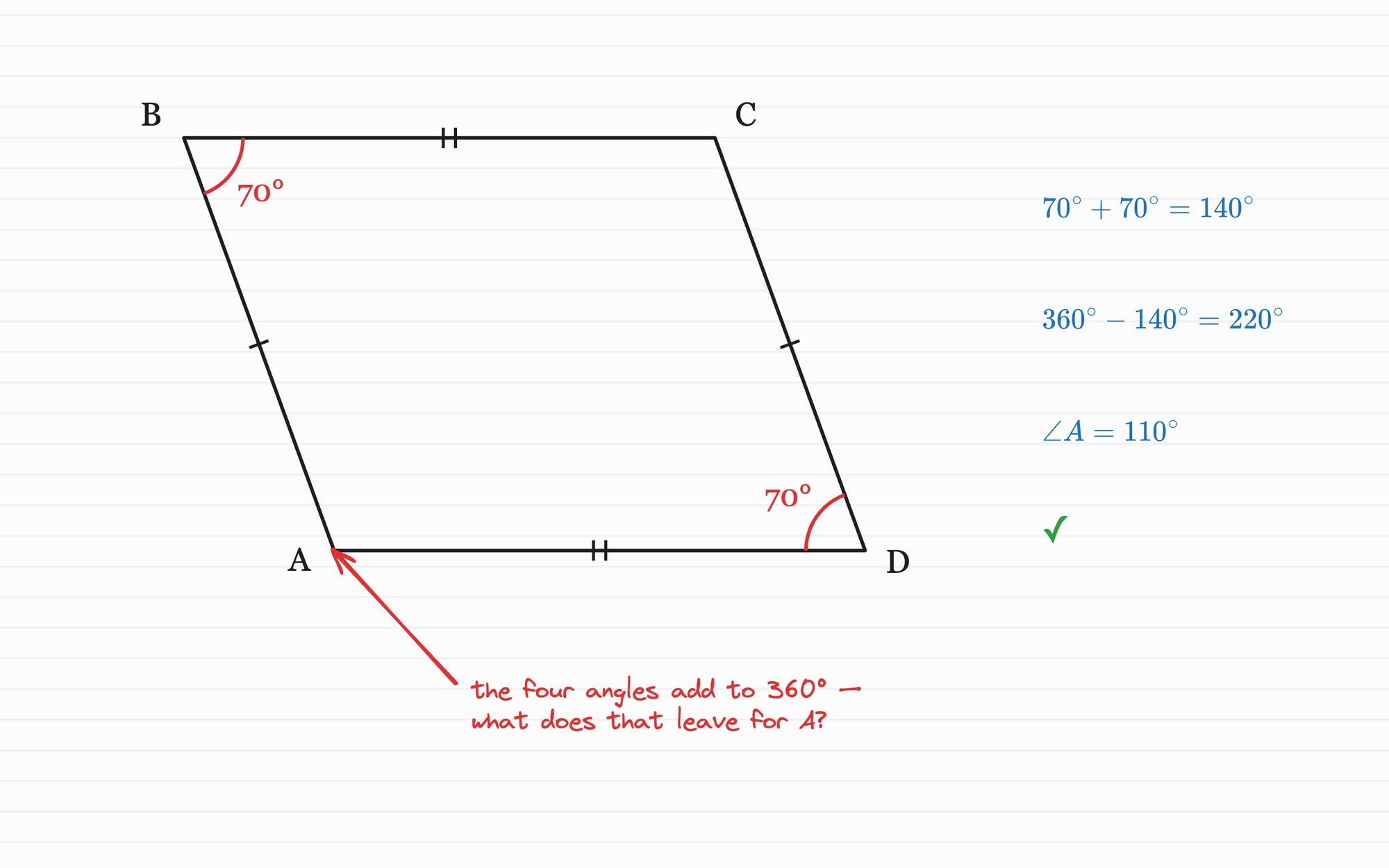
The angle they couldn't name.
Questions
Does it cover proofs?
Yes. Congruence and Similarity are units 2 and 3, and proof is exactly the kind of work that suits a shared board: your student writes a step, SmartWit asks which theorem licenses it, and the reasoning gets built line by line instead of copied.
Can it actually draw the figures?
It draws them properly. Figures, angle marks and graphs are computed by a math engine and rendered exactly rather than sketched freehand by a language model. A 70° angle on the board is 70°.
Can it help with tonight's homework from class?
Read it out, or write it on the board. It gets worked inside the course context, so tonight's homework also moves the mastery estimate for the unit it belongs to.
What grade is Geometry for?
Typically grades 9–11. Most students take it after Algebra 1, and SmartWit teaches both, so a shaky algebra step inside a geometry problem gets picked up rather than skipped.
Ready to learn out loud?
Talk and draw your way unstuck, with a tutor that draws right back.